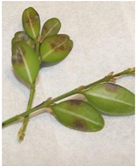
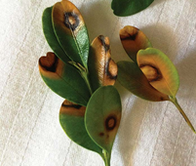
Boxwoods (Buxus spp.) are one of the most abundant shrubs used in many landscapes. Boxwood blights are a fungal disease that can be fatal if no measures are taken to manage the disease at the early stage of infection and symptom appearance. There are two different fungal pathogens involved with blights – Volutella buxi and Calonectria pseudonaviculata .
A Volutella buxi infection turns leaves light green-yellow, which transition to bronze and finally become yellow-tan in color (Table 1). This is known as Volutella blight. This fungal pathogen also can infect stems, resulting in loose or peeling, yellowish bark (Table 1).
Another fungal pathogen known as Calonectria pseudonaviculata (previously called Cylindrocladium pseudonaviculatum or Cylindrocladium buxicola) can cause boxwood blight that may be termed as Calonectria blight. Unlike Volutella blight, infection from Calonectria manifests as dark leaf spots that coalesce to form brown blotches (Table 2, left). While Volutella-affected leaves can be attached to the stem for a longer time, Calonectria-affected leaves drop off very quickly, known as defoliation, giving the plant a barren appearance.
A key symptom that differentiates Calonectria blight from Volutella blight of boxwood is that narrow vertical black streaks (cankers) develop on green stems due to Calonectria infection, while Volutella-infected stems show brown to black girdling streaks, followed by loosening or peeling of the bark (Yang et al., 2021).
Both fungal pathogens can survive on infected plants or fallen leaves on the ground from one year to another, known as overwintering. The spores produced on infected leaves and stems during the growing season can be splash-dispersed through irrigation, rainfall, wind or pruning tools. This can spread the disease within a plant or to nearby boxwood shrubs. Environmental stress, such as drought, excessive water or winter injury, can make boxwood plants vulnerable to infections.
Disease Management
Prune out infected branches and destroy them by burning or hauling away in a trash bag. Pruning dense shrubs also can help in air movement, sunlight penetration and keeping canopy humidity low. Sanitize pruning tools by dipping in 10% bleach or 70% ethyl alcohol between each cut. Do not prune when foliage is wet. If possible, remove infected fallen leaves and litters.
Alleviate plant stress by providing irrigation and fertilization as needed. However, it is better to irrigate through drip irrigation and avoid overhead sprinklers to keep foliage dry. Do not use horticultural fabric as a mulch to suppress weed growth. It is better to use bark or compost mulch that may help retain moisture and promote root growth.
Fungicidal Control
A combination of chlorothalonil (trade names include Bravo, Daconil or Fung-onil) and thiophanate methyl (Cleary 3336) can provide good control of Volutella blight if used preventatively or at the very early stage of symptom expression. Removal of highly infected stems by pruning before fungicide application can improve the efficacy of the products. Other products that are registered for the control of Volutella blight include propiconazole, copper and mancozeb.
For preventing Calonectria blight, fungicides Heritage, Medallion, Mural or Palladium can be used in alternation with Daconil.
Information taken from WV Extension and written by: Mahfuz Rahman, WVU Extension Plant Pathology Specialist