Regular laboratory testing of agricultural waste and compost allows growers to apply organic nutrients efficiently, lower fertilizer expenses, and maintain environmental compliance. The North Carolina Department of Agriculture and Consumer Services (NCDA&CS) Agronomic Services Division provides comprehensive testing services for producers utilizing animal manures, lagoons, compost, and industrial byproducts.
1. Preparing and Packaging Samples
To ensure safety and precise analysis, samples must be packaged according to their physical state:
- Liquid Samples (e.g., Lagoon Liquid, Slurry):
Use clean, leak-proof plastic bottles.
Fill the container leaving at least 2 inches of head space to allow for gas expansion during transport.
Never use glass containers, which can shatter under pressure.
- Solid Samples (e.g., Poultry Litter, Scraped Solids, Compost):
Submit samples in heavy-duty, sealed plastic bags to prevent odor escape and moisture loss.
- Submission Forms:
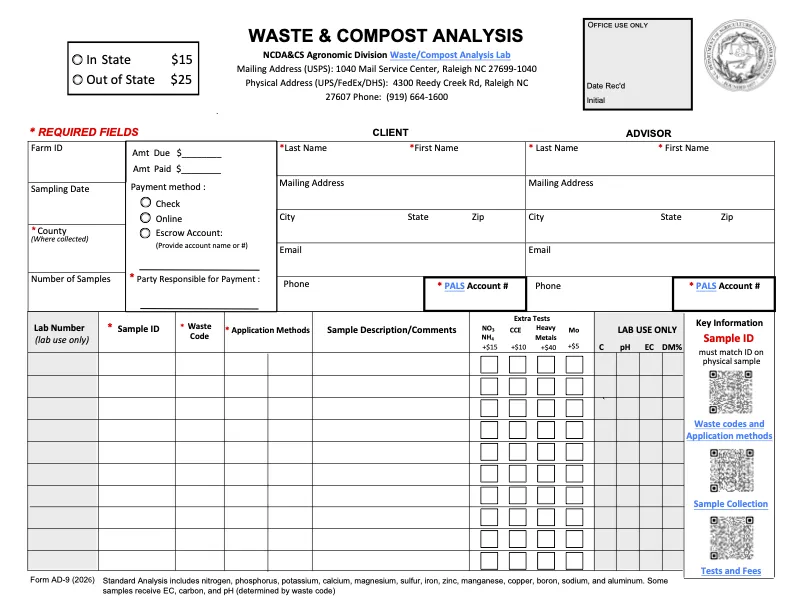
Every shipment must include a completed Waste & Compost Sample Submission Form. Clearly label packages directed to the Waste Analysis Lab to avoid routing delays to the Soil Testing facility.
2. Waste Codes & Application Methods
Accurate laboratory calculations depend on selecting the correct parameters on your submission form:
Selecting the Proper Waste Code
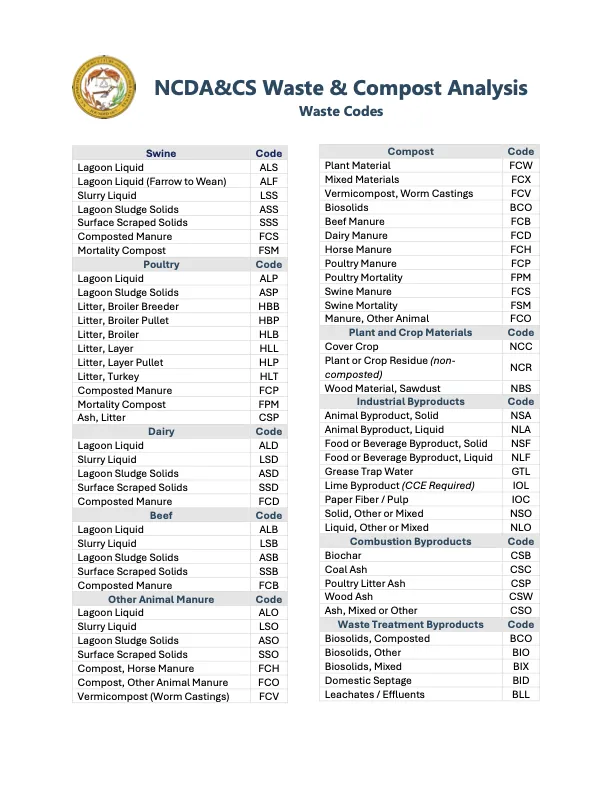
The NCDA&CS uses specific codes to classify materials and accurately determine nutrient availability. Common examples include:
CategoryMaterial DescriptionWaste CodeSwineLagoon Liquid / Liquid SlurryALS / LSSPoultryBroiler Litter / Turkey LitterHLB / HLTDairyLagoon Liquid / Surface Scraped SolidsALD / SSDBeefLiquid Slurry / Surface Scraped SolidsLSB / SSBCompostSwine / Poultry / Yard-Plant MaterialsFCS / FCP / FCW
Defining Land Application Methods
Growers must indicate at least one intended land application method so the lab can calculate effective nutrient availability:
- Liquid Application:
- IR – Surface Irrigated
- IN – Soil Injected
- Solid Application:
- BR – Broadcast without soil incorporation
- SI – Broadcast with soil incorporation
3. Shipping and Delivery Options
Submissions can be routed to the Raleigh facility via multiple methods:
1.By Courier (Recommended for Extension Clients):
Many North Carolina Cooperative Extension county offices offer a scheduled courier service that transports laboratory samples directly to the Agronomic Division.
2.In-Person Drop-Off:
Deliver samples directly to the Agronomic Division loading dock in Raleigh (4300 Reedy Creek Rd) Monday through Friday between 7:00 a.m. and 4:00 p.m.
3.Commercial Freight or Mail:
Ship via UPS/FedEx to 4300 Reedy Creek Rd, Raleigh, NC 27607, or via USPS to 1040 Mail Service Center, Raleigh, NC 27699 (allow additional delivery time for postal mail).